
Your Cart
Choosing the Right Christmas Chocolate Packaging Trays for Gift Products
Christmas turns chocolate from a snack into a gift, and that changes what the packaging has to do. A bar that survives a lunchbox can still arrive at a holiday party as a cracked, scuffed, sugar-bloomed mess. When pieces are packed for gifting, they travel further, sit longer on a shelf, and get judged by appearance before anyone tastes them. The tray inside the box is what decides whether the assortment arrives looking like a gift or like a return.
This guide is written for bakeries, chocolatiers and food brands building Christmas gift sets. It covers the failure modes that show up only in a boxed assortment, how to match cavity layout to the product, why the material matters in cold weather, and the questions to ask a supplier before you commit to a festive run. If you are comparing formats rather than reading a general chocolate-packaging overview, start here.
Why Gift Sets Fail Differently From Everyday Packs
A single bar in a sleeve has one thing to protect. A Christmas assortment has a dozen pieces fighting each other inside the same box. Three failures dominate: pieces knocking together until corners chip, friction rubbing the tempered surface into a dull bloom, and thin walls flexing under the stacked weight of a shipped carton. None of them appear in an empty-tray sample — they appear after a filled box has been carried, stacked and stored for a week.
The mechanism is simple: movement plus contact. Remove either one and most gift-set damage disappears. That is why a food-grade plastic chocolate tray with defined cavities is not a cosmetic upgrade — it is the part that keeps each piece in its own lane from the packing line to the recipient.
Match the Cavity to the Piece, Not the Other Way Around
The most common spec mistake is picking a tray with a nice-looking cavity count and then forcing the product to fit. Work in the opposite direction: measure the real piece, add clearance for coating and tolerance, then choose the layout.
| Gift format | Tray requirement | What goes wrong if you skip it |
|---|---|---|
| Assorted truffles / pralines | Round cavities sized to each diameter, with a snug fit | Pieces roll and collide; coatings crack at the contact point |
| Brittle / toffee pieces | Firm walls, shallow wells, a rigid unset base | Corners chip and edges cloud over from surface rub |
| Mixed chocolate + biscuit gift box | Separate compartments for soft and crisp items | Moisture migrates; crisp pieces go soft in a sealed box |
| Petite fours / macaron-style gifts | High-wall individual cells with a lid that never presses the top | Tops mark against the film and the arrangement collapses |
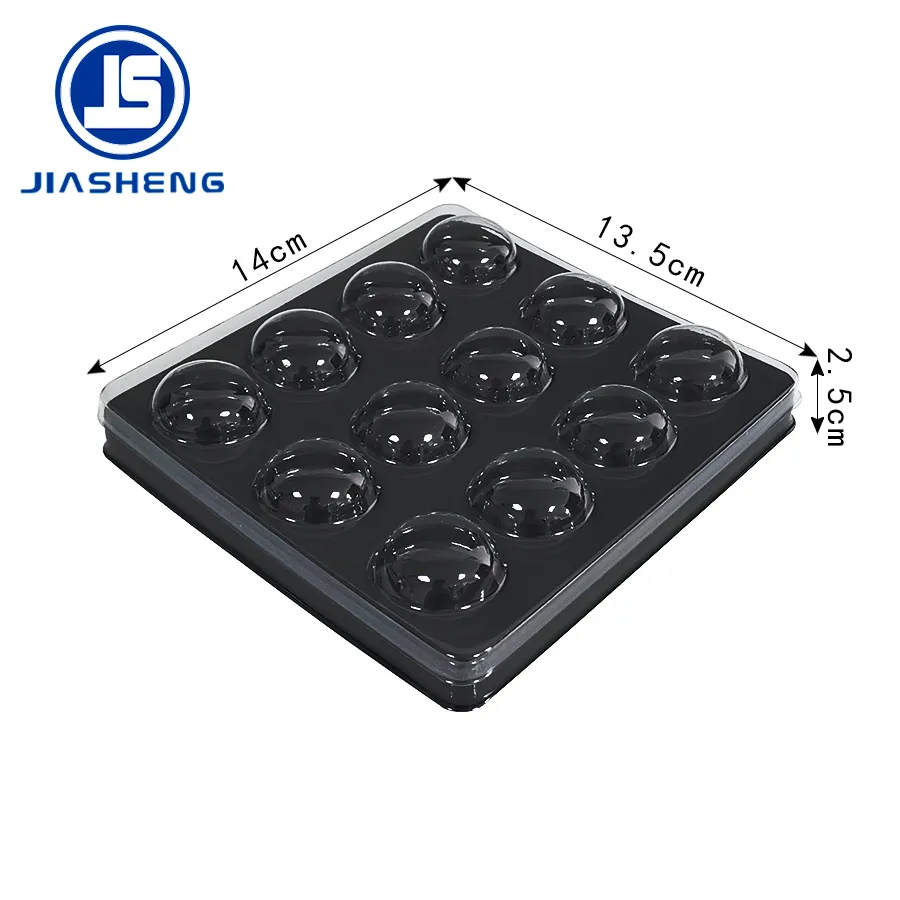
The same divide-and-hold logic that protects a macaron box insert applies to chocolate: a cavity per piece, walls tall enough to stop lateral travel, and a lid that clears the product rather than resting on it. Bakeries that already run a bakery tray insert will recognise the pattern immediately.
Material Behaviour in a Cold Christmas Chain
Chocolate has a narrow comfort band, and winter shipping tests it from both ends. In an unheated warehouse or a delivery van, a thin, brittle tray can crack at the flange — and once the tray fails, the pieces have nothing holding them apart. Conversely, a tray that insulates too well can slow temperature change and make condensation more likely when a cold box is opened in a warm room. The answer is not a thicker tray for its own sake; it is a food-grade material with the right stiffness and a lid design that manages moisture.
Ask for the food-contact declaration and the actual material grade, not just the word “food-grade” on a datasheet. For gift assortments that include several textures, a confectionery insert solution with stable cavity geometry does more for shelf appearance than any printed message on the box.
Design the Insert for the Packing Line, Not Just the Photo
A beautiful tray that takes ten seconds per box to load is an expensive tray. If your team assembles hundreds of gift sets a day, the insert should drop into the outer box in one motion and the cavities should line up with the way operators actually place pieces. A tray that needs a manual nudge to sit flat, or a lid that closes only one way, becomes a bottleneck at exactly the moment your volume peaks. Test assembly with the people who will run it, not in isolation at a desk.
Standardise where you can. One common outer box with a seasonal ribbon, sleeve or sticker lets you reuse the same rigid insert across several festive SKUs, keeping the line stable and the tooling cost down. That matters late in the season: when a new tool is no longer realistic, a proven insert in a standard size is what lets you ship a gift set at all. Confirm the insert height clears the lid, then lock the layout early so the packing line can be briefed before the first order closes.
Recyclability Without Compromising Protection
A gift tray is judged twice — once at the recipient, and again at disposal. A mono-material tray in a recyclable plastic stream is easier for customers to sort than a mixed construction of tray, film and paper board that must be pulled apart. That does not mean sacrificing protection: cavity geometry and wall stiffness do the work, not extra layers. Choose the simplest structure that keeps the pieces separated and let the outer box carry the festive print.
For brands with sustainability claims on the box, make sure the insert does not contradict them. A recyclable tray with a clear food-contact declaration is a simple story to tell; a laminated multi-material insert with a printed message about recycling is not. Decide the disposal story at the spec stage, because the insert is the part the customer handles longest.
The Gift-Ready Checklist Before You Order
- Measure the finished piece including coating, then add clearance for tolerance and handling.
- Fill a sample tray, close the real lid, and shake it gently: no piece should change compartment.
- Drop the filled tray from shelf height once — corners must not chip and the base must not flex.
- Stack three filled gift boxes and check that the top lid never compresses the product below.
- Confirm the tray size fits your existing gift box, or specify the box and tray as one assembly.
Five Questions to Ask Your Tray Supplier
- Can you tool a cavity to my exact piece dimensions, and what is the minimum run for a custom layout?
- What is the food-contact certification for this material, and is it valid for both chocolate and biscuit components?
- Do you have an existing gift-tray mold close to my layout that would let me ship in time for the season?
- What is the stacked load rating of the filled tray, and does the lid clear the tallest piece?
- Can you deliver tray and lid as one fitted assembly so my line does not need a manual alignment step?
Frequently Asked Questions
What tray is best for a mixed chocolate gift box?
One with defined, sized cavities and separate compartments for soft and crisp pieces. The goal is to stop pieces touching each other and to keep moisture from migrating between textures.
How do I stop chocolate from cracking in transit?
Secure each piece in a snug cavity so it cannot travel, use walls with enough stiffness to resist stacking load, and leave the lid clear of the product surface. Most cracks happen from pieces colliding, not from a single impact.
Is a custom tray realistic this close to Christmas?
Usually not for a brand-new tool. An existing mold or a standard compartment layout is the realistic route for a late season, which is why choosing a supplier with a mold library matters more than a perfect bespoke drawing.
Should the tray be branded or the outer box?
Brand the outer box; keep the tray functional and food-safe. The insert earns its cost by protecting the product and presenting it neatly, not by carrying print that rubs onto the chocolate.
Can one tray hold both chocolates and macarons?
Yes, if you use separate compartments and a lid that clears the taller, more fragile item. Treat it as two products sharing one gift box, each with its own holding geometry.
Building a Christmas Chocolate Gift Set?
Food-grade compartment trays and confectionery inserts that keep each piece separated, protected and gift-ready. Free samples for evaluation.
Request a Free Sample